
Product Overview
TIP: Click here to download the FREE Smart Peptide Tracker for information on all peptides, oils, supplements, research, dosage, reconstitution, protocols, interactions, scheduling and more.
Ask ChatGPT: What is MOTS-c good for?
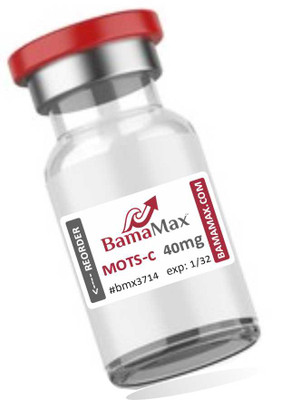
BamaMax™ presents premium-grade MOTS-c, a synthetic 16-amino acid mitochondrial-derived peptide (MDP) specifically designed for in vitro laboratory evaluation and biochemical research. This biologically active micropeptide acts as a powerful molecular tool for investigators exploring metabolic homeostasis, insulin sensitivity pathways, and mitochondrial-nuclear retrograde signaling. Supplied as a highly stable, white lyophilized powder in a sealed glass research vial, our MOTS-c ensures optimal structural integrity and long-term storage compatibility for precise experimental design.
Product Overview & Mechanism
MOTS-c (Mitochondrial Open Reading Frame of the 12S rRNA-c) is a unique, naturally occurring peptide encoded within the mitochondrial genome rather than the nuclear DNA. It functions as an endocrine-like signaling factor that translocates to the nucleus under metabolic stress to regulate nuclear gene expression.
The primary mechanism of MOTS-c centers on the activation of the AMPK (AMP-activated protein kinase) signaling pathway and the subsequent upregulation of glucose transporter 4 (GLUT4). By modulating cellular energy sensors, MOTS-c promotes fatty acid oxidation, enhances glycolysis efficiency, and restores metabolic equilibrium in insulin-resistant cell models. Its dual action as an intra-organelle messenger and a systemic metabolic regulator makes it an essential agent for profiling mitochondrial fitness, adaptive stress responses, and metabolic plasticity.
Technical Specifications
| Attribute | Specification Details |
|---|---|
| Product Name | MOTS-c |
| Synonyms | Mitochondrial-Derived Peptide MOTS-c, Mitochondrial ORF 12S rRNA-c |
| Molecular Formula | C₁₀₁H₁₅₂N₂₈O₂₂S₂ |
| Molecular Weight | 2174.62 Da |
| Sequence Length | 16 Amino Acids |
| Physical Format | White Lyophilized (Freeze-Dried) Powder |
| Purity Grade | ≥99% via HPLC-UV and Mass Spectrometry (MS) |
| Target Axis | AMPK Pathway / Mitochondrial-Nuclear Signaling Network |
| Documentation | Lot-specific Certificate of Analysis (COA) included |
Core Research Applications
- Metabolic Homeostasis Tracking: Investigating glucose uptake dynamics, lipid oxidation rates, and insulin sensitivity profiles in metabolic disease models.
- Mitochondrial Signaling Pathways: Mapping retrograde communication vectors between the mitochondrial network and nuclear transcription factors.
- Cellular Longevity & Senescence: Evaluating the impact of mitochondrial open reading frame expression on physiological decline and cellular vitality markers.
- Exercise Mimetic Profiling: Modeling cellular adaptation to metabolic stress, muscular energy expenditures, and system-wide nutrient sensing.
Handling & Storage Guidelines
To preserve maximum biological activity and prevent degradation, follow these sequence-specific storage protocols:
- Long-Term Storage (Dry): Keep the raw, lyophilized powder sealed inside its primary vial and store at -20°C for up to 1 year, or -80°C for extended preservation away from ambient moisture.
- Reconstitution Protocol: Reconstitute using sterile, research-grade solvents or bacteriostatic water tailored to your specific in vitro assay constraints. Gently swirl the vial to completely dissolve the cake; do not shake or agitate aggressively.
- Post-Reconstitution Storage: Store the liquid solution at 2°C to 8°C and utilize within 14 days. For multi-week studies, aliquot the solution immediately into single-use volumes and store at -20°C or lower to prevent destructive freeze-thaw cycles.
LABORATORY RESEARCH USE ONLY: This product is synthesized, distributed, and sold strictly for laboratory research, in vitro testing, and analytical methodologies. MOTS-c has not been evaluated or approved by the FDA for human or veterinary applications, clinical diagnostics, therapeutics, or consumer administration. All handling must be conducted by qualified laboratory professionals in controlled scientific environments.